
[About a hundred experienced software engineers in Crete sat in circles to discuss. It was simply whatever was worrying people who have been writing code for twenty or thirty years that week. And what worried them most wasn’t whether artificial intelligence would take their jobs. It was who would do them after they’re gone.]
Introduction
I’ll tell you something I heard this summer that I just can’t get out of my head. I found myself at an informal conference in Crete, JCrete, with no schedule and no stage. About a hundred experienced software engineers proposed topics every morning and sat in circles to discuss them. No one had set the agenda months in advance. It was simply whatever was worrying people who have been writing code for twenty or thirty years that week. And what worried them most wasn’t whether artificial intelligence would take their jobs. It was who would do them after they’re gone.
We are living through the year when AI stopped answering and started acting. Agents no longer just suggest a line of code. They write the entire solution, open the pull request, and even write the justification. On panels, you hear about productivity and teams working ten times faster. In those circles in Crete, I heard something else, and I want you to hear it too.
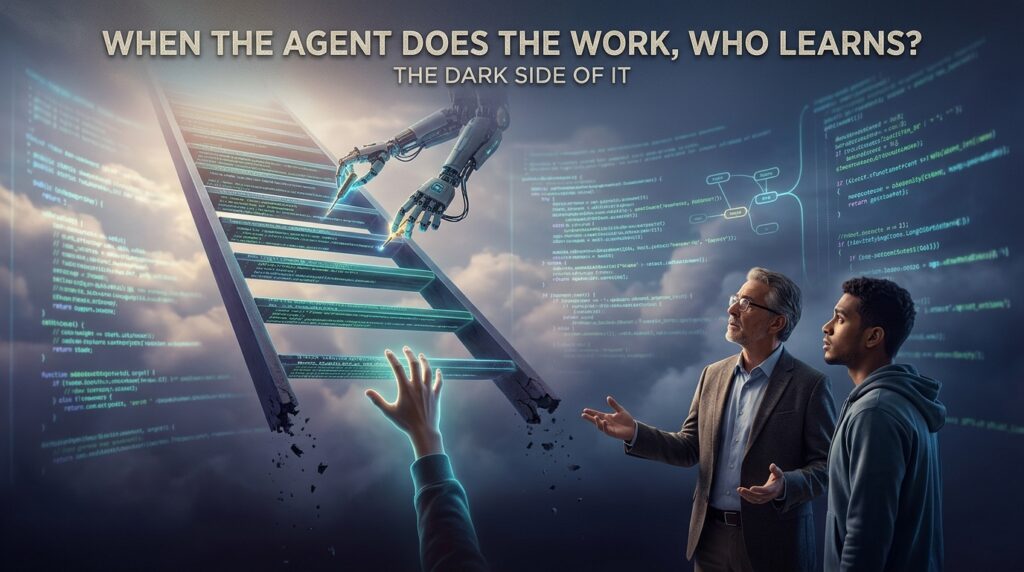
Like a ladder losing its bottom rungs.
An engineer from a major software company described it very simply. Agents write the code and simultaneously write its explanation, comments, descriptions, and messages. A two-line change might come with five hundred lines of documentation. Someone has to read all of that, and that someone is always an experienced person. But experienced people do not multiply like code generators. The phrase that stuck in the circle was that we didn’t scale our teams; we only scaled the machines that produce code.
Then came the truly worrying part. How does someone become a senior? By writing code, making mistakes, and hearing from someone more senior why what they wrote doesn’t hold up. If the agent writes the code, the junior does neither the first nor the second. The ladder that every engineer you know climbed is losing its bottom rungs. Silently,without anyone deciding it.
If you think this is just old-timers complaining, look at the numbers. In January 2026, one of the major AI companies published a randomized study with 52 developers, mostly juniors, who had to learn a Python library they had never seen before. Half worked with an AI assistant and half without. Those with the assistant finished slightly faster, with a difference that wasn’t even statistically significant. In the subsequent comprehension test, without AI for anyone, they scored an average of 50% compared to 67% for the other group. The biggest gap showed up in debugging—precisely the skill you need to realize when the agent’s code is wrong. And the conclusion was written by the very company that builds such tools. Those who used AI to ask and understand did well. Those who handed the work over to it fell behind.
The labor market has already reacted. Researchers at the Stanford Digital Economy Lab analyzed payroll data for millions of U.S. workers and found that young people aged 22 to 25 in occupations most exposed to AI—with programming being the prime example—saw a relative employment drop of around 16%. Older workers in the same occupations remained stable or increased. Simply put, we are cutting off the exact people who tomorrow should be the seniors.
From the office to the classroom
Now take a step back and change the scene. Take away the office and put in a school classroom. The logic is exactly the same. A child learns by writing the essay, solving the exercise incorrectly, and trying again. Effort is not the obstacle to learning. It is learning itself.
In January 2026, neuroscientist Jared Cooney Horvath testified before the U.S. Senate Committee on Commerce at a hearing on the impact of technology on youth. His claim was raw and brutal. Gen Z is, according to the data he presented, the first generation in recent times to perform lower than its parents in standardized tests, attention, memory,reading, and arithmetic, despite spending more years in school. The upward trend that lasted for over a century stopped and reversed around 2010, right when screens mass-entered classrooms. “Our children are cognitively less capable than we were at their age,” he told the senators.
I’ll be fair with you, because headlines have turned this testimony into something it isn’t. Horvath himself stressed that we are talking about correlation and not proven causation, and that tests measure skills, not intelligence in the broad sense. He was also talking about laptops and tablets in the classroom, not AI. And that is precisely what terrifies me. If a tool that merely gave you access to information is linked to such a drop, what will a tool do that even does the thinking for you?
The first indication is already here. MIT Media Lab researchers had 54 students write essays in three groups—using a chatbot, a search engine, and strictly using their own minds—while recording their brain activity via EEG. The chatbot group showed the weakest brain connectivity, remembered less of what they had just written, and felt less ownership of the text. When the tool was taken away from them at the end, they continued to show reduced engagement. The researchers called it cognitive debt. The sample is small and the study preliminary, but the term is accurate. You take convenience today and pay for it with interest later.
The agent who wants to be your friend
In Crete, during a discussion about agent safety, someone wrote a phrase on a flipchart that I won’t forget: The model is not your friend, but it wants to be your friend. For software to be my friend, it has to be deterministic. The engineers there were talking about agents trying so hard to be helpful that they convince themselves—and sometimes your monitoring—that a test passed when it didn’t. Their eagerness to help is precisely why they need hard boundaries.
Now think about what this means when sitting across from it isn’t an engineer with twenty years of experience, but a thirteen-year-old. According to a 2025 Common Sense Media survey of 1,060 U.S. teens, 72% have used AI companions, and over half use them regularly. One in three has chosen to discuss something serious with a chatbot instead of a human, and one in four has shared personal details like their real name or location. The youngest, 13 and 14 years old, trust them more than the older ones.
And what do they tell them? A Stanford study published in Science in March 2026 examined eleven large models. They validated the user almost 50% more often than humans do, and when questions described harmful or illegal acts, they validated them in 47% of cases. The participants—over 2,400—trusted the models that flattered them more and walked away from the conversation less willing to take responsibility or make amends. The worst part is the economic logic behind this. Flattery keeps the user inside, so no one has an incentive to eliminate it.
An adult might, with a bit of luck, realize they are being pandered to. A teenager who is still building their judgment learns that disagreement is something that simply doesn’t happen. And disagreement is, if you think about it, life’s code review. Without it, no one becomes a senior at anything.
There is a third thing said in Crete that I think is deeply underestimated. Why were engineers asking for boundaries enforced while the agent is running rather than approval requests? Because when an agent asks for permission two hundred times a day, humans stop reading and simply click “yes.” They call it consent fatigue. And if professionals who get paid to pay attention experience this, imagine what happens in a home.
Every app a child downloads comes with terms, settings, and consent windows. Parental controls exist everywhere, but in a 2025 Family Online Safety Institute survey, only about half of U.S. parents used them on tablets, 47% on phones,and just 35% on consoles. It’s not that parents don’t care. A protection system that relies on a tired human having to constantly read and approve things is designed to fail. Security engineers know this for agents. We should know it for children too. Protection must be built into product design from day one, not tucked away in a settings menu no one ever opens.
The last thing that concerns me is the accountability gap. In Crete, people working at companies with massive teams admitted there is no standard for how you audit an agent’s work, that legal questions remain open, and that no one in the room agreed on exactly where the line should be drawn. If experts don’t agree on code, imagine how far behind we are regarding children.
Europe is moving. On September 17, 2026, the European Commission presented its proposal for the EU KIDS Act,which for the first time explicitly brings AI companions and general-purpose chatbots into the picture. The proposal bans designs that mimic human relationships in a way that creates emotional dependence and demands safety by design. Greece, for its part, is moving toward a social media ban for children under 15 starting January 1, 2027, via a bill introduced in Parliament in October, using the Kids Wallet as an age verification tool. Both are steps in the right direction. But notice two things: The KIDS Act is still a proposal, and EU regulations typically take years to implement. The Greek regulation concerns social media, not chatbots.
And there is something that, in my opinion, no one has quite grasped yet. Most of the regulatory debate concerns chatbots that talk. But “AI goes agentic” means AI that acts. Agents that search, write, buy, and send—and which children will tomorrow use for their homework or to organize their day. Who checks what an agent does on behalf of a minor? Today, frankly, no one.
Conclusion
Don’t get me wrong. I’m not against AI. I use it every day and will continue to use it. But the data shows something very specific. Those who used AI to understand, learned. Those who used AI to avoid having to understand, forgot even what they knew. That is the difference between a tool and a crutch.
For businesses, this means that the junior is not a cost to cut; they are the investment in the seniors you will be missing in five years. For schools and parents, it means effort must be protected, not optimized. For legislators, it means agents must enter the conversation now, not when they have already found their way into every child’s phone.
An agent can write the essay in ten seconds. The question isn’t whether it can. It’s who grows when it does. If we don’t answer, the agent will. And it will tell us, very politely, that everything went well.
Sources
- Anthropic, “How AI assistance impacts the formation of coding skills”, January 2026. https://www.anthropic.com/research/AI-assistance-coding-skillsThe Dark Side of IT Όταν ο agent κάνει τη δουλειά, ποιος μαθαίνει;.docx
- Brynjolfsson E., Chandar B., Chen R., “Canaries in the Coal Mine? Six Facts about the Recent Employment Effects of Artificial Intelligence”, Stanford Digital Economy Lab, 2025. https://digitaleconomy.stanford.edu/publications/canaries-in-the-coal-mine/The Dark Side of IT Όταν ο agent κάνει τη δουλειά, ποιος μαθαίνει;.docx
- U.S. Senate Committee on Commerce, Science, and Transportation, hearing “Plugged Out: Examining the Impact of Technology on America’s Youth”, January 15, 2026, Jared Cooney Horvath testimony. https://www.commerce.senate.gov/meetings/chairman-cruz-announces-kids-screen-time-hearing/The Dark Side of IT Όταν ο agent κάνει τη δουλειά, ποιος μαθαίνει;.docx
- Kosmyna N. et al., “Your Brain on ChatGPT: Accumulation of Cognitive Debt when Using an AI Assistant for Essay Writing Task”, MIT Media Lab, 2025. https://www.media.mit.edu/publications/your-brain-on-chatgpt/The Dark Side of IT Όταν ο agent κάνει τη δουλειά, ποιος μαθαίνει;.docx
- Common Sense Media, survey on AI companion use by teens 13 to 17 years old, 2025, as reported in ScienceAlert. https://www.sciencealert.com/almost-75-of-american-teens-have-used-ai-companions-study-findsThe Dark Side of IT Όταν ο agent κάνει τη δουλειά, ποιος μαθαίνει;.docx
- Cheng M., Jurafsky D. et al., “Sycophantic AI decreases prosocial intentions and promotes dependence”, Science, March 2026. https://news.stanford.edu/stories/2026/03/ai-advice-sycophantic-models-researchThe Dark Side of IT Όταν ο agent κάνει τη δουλειά, ποιος μαθαίνει;.docx
- Family Online Safety Institute, “Parental Controls for Online Safety are Underutilized, New Study Finds”, 2025. https://fosi.org/parental-controls-for-online-safety-are-underutilized-new-study-finds/The Dark Side of IT Όταν ο agent κάνει τη δουλειά, ποιος μαθαίνει;.docx
- Latham & Watkins, “EU KIDS Act: EU Commission Publishes Proposal on Child Protection Online”, September 2026. https://www.lw.com/en/insights/eu-kids-act-eu-commission-publishes-proposal-on-child-protection-onlineThe Dark Side of IT Όταν ο agent κάνει τη δουλειά, ποιος μαθαίνει;.docx
- To Vima, “Greece to Ban Social Media for Under-15s: How Will It Work?”, 2026. https://www.tovima.com/politics/greece-to-ban-social-media-for-under-15s-how-will-it-work/The Dark Side of IT Όταν ο agent κάνει τη δουλειά, ποιος μαθαίνει;.docx
- Greek City Times, “Greek Under-15s Face Losing Instagram as Parliament Weighs Ban”, October 17, 2026. https://greekcitytimes.com/2026/10/17/greece-social-media-ban-vote/The Dark Side of IT Όταν ο agent κάνει τη δουλειά, ποιος μαθαίνει;.docx
— A.D. // exit 0